Thursday, March 31, 2022

Cardamom (Elettaria cardamomum)


Cardamom essential oil is a wonderfully supportive oil for your digestive system. It is made from steam distilling the seeds of the cardamom plant. 


Cardamom is often found as a cooking spice, and it's a close cousin to Ginger. It is native to Southeast Asia, where it's a common spice used in Indian dishes and teas. You'll usually find it in Chai tea, one of my favorites! Both the herb and the essential oil are good for your digestive system. Cardamom oil is stimulating and energetic. It creates movement and warmth wherever it's applied.

When using cardamom essential oil to support digestive health, you can add a few drops to a carrier oil like olive oil or jojoba. Massage into your abdomen in a clockwise motion (with 12 o'clock being above your belly button). Or, try this recipe!


Cardamom essential oil has a great scent. It's spicy and warm, with a cool, almost eucalyptus-like finish. 


Cardamom essential oil is also very supportive for your respiratory system. It contains a component called 1,8 cineole, which is great for respiratory health. So while you're enjoying the scent of cardamom essential oil, you're also supporting your health!


Cardamom: The Oil of Objectivity


Energetically, this oil helps us to stay level headed in times of anger. Use Cardamom to help you feel mentally balanced and to not lose control of your emotions in difficult situations.

Do you find yourself obsessing about things that make you mad? Cardamom essential oil helps us to break down these feelings of frustration and redirects that energy to the solar plexus, the center of responsibility. In this way, Cardamom is a good oil to use for the Third Chakra, or the solar plexus chakra.

When you find yourself re-hashing feelings of anger or resentment towards someone or some situation, use Cardamom to help you work through it. Rub a couple drops of Cardamom over your solar plexus and practice deep breathing while you focus on letting go of your negative feelings. Cardamom can help us to stop objectifying others and to stop seeing them as inconveniences. Cardamom helps us take personal responsibility for our feelings.

Negative emotions that Cardamom can assist with - being easily frustrated, anger, objectifying others, blaming, unable to think clearly due to anger and resentment.

The Positive emotions Cardamom can help - being objective, self-control, respectful, tolerant, patient, and mentally sober.


Tuesday, March 1, 2022

Basil


Did you know that this popular culinary herb can be made into an essential oil? The oil is steam distilled from the leaves, stems, and flowers of the basil plant. 

I probably don't have to describe for you what Basil smells like. It's a wonderful spicy, sweet, herbaceous, green, and somewhat camphorous scent.

I grew Basil in my garden last summer and I loved grabbing a couple leaves and crushing them in my hand to release the scent. Bees love the flowers!

Basil essential oil has many therapeutic properties. It is anti-bacterial, anti-inflammatory, anti-oxidant, and a decongestant.


Basil essential oil can be beneficial for your skin. It can help keep it clear and clean. Add a drop of two to your favorite carrier oil such as olive oil or jojoba, which are both also great for your skin.

Just like the herb itself, Basil essential oil can be used in cooking. You only need a drop or two, as it's much more concentrated, and the flavor is intense. Also make sure that the Basil oil you use is certified as food grade and that it's not just a synthetic fragrance.

Basil essential oil can help with focus. Try diffusing it or using it in an inhaler next time you need to study or concentrate on a task.


When shopping for Basil essential oil, you may encounter more than one kind. The two most common are Sweet Basil and Tulsi (Holy Basil.)

Holy Basil is a chemotype of Basil (Sweet Basil), meaning it is a different version of it. It contains a component called eugenol, which is also found in clove and cinnamon. Because of this eugenol, Tulsi basil has a spicy, sweet aroma.

Tulsi Basil essential oil has many therapeutic benefits. It's great for muscle aches and soreness, and can help support your immune system. Tulsi basil essential oil is an adaptogen. This means that it can "adapt" to give you what wellness support your body needs. For example, it can be either relaxing or stimulating. Pretty cool little plant, huh?!


Basil: The Oil of Renewal

Basil essential oil can be helpful for those experiencing adrenal exhaustion, as well as nervousness, anxiousness, and despair. The smell of basil oil can bring strength to the heart, and relaxation to those people under a lot of stress and mental strain.

Basil essential oil may be helpful for those trying to give up stimulants, as basil can help restore our natural energy. It can give hope and optimism. It is a wonderfully supportive oil for those who are tired in both body and mind.


Basil and the Two of Wands

In the Herbal Tarot, Basil is associated with the Two of Wands. In this card, a young nobleman holds a sphere, or globe, and seems to be surveying all that is available to him. This could be a very positive outlook, or a very self-centered view. This card teaches us to not mistake material wealth for spiritual wealth. Basil can help with this by supporting idealism and a clear inner vision. It can help us to follow through on our projects.  

Here is a recipe for using Basil essential oil to make a soothing oil for tired, achy muscles. You can use either Sweet Basil or Tulsi Basil for this blend. Combine the essential oils in the jojoba. Make sure to use a glass bottle or a PET essential oil safe bottle. 


Tuesday, February 1, 2022

Aborvitae


I really love this oil because it smells like the woods I grew up in, in the Pacific Northwest. And no wonder, because Arborvitae oil is made from the bark of the Western Red Cedar found in the northwestern part of the US and in Canada. It basically smells like a deep, damp forest.


The Western Red Cedar (Thuja plicata), has often been known as the "Tree of Life". It has been used by ancient civilizations to enhance their potential for spiritual communication during rituals and ceremonies.

Arborvitae is a wonderfully supportive oil in that it is antibacterial, antifungal, and makes a great insect repellant! Body systems most affected by Arborvitae are the Respiratory System and Emotional Balance. Check out this recipe for making a furniture polish with Arborvitae! 


Arborvitae is the Oil of Divine Grace.

This oil helps us stop the constant struggle for achievement and learn to accept the flow of abundance. Arborvitae can be grounding and calming. It helps us to see the grace in our everyday lives and to find balance.

Arborvitae's Latin name means "to sacrifice". Use this oil to help you surrender to divine grace and feel in the flow of life.

The positive emotions of Arborvitae: peaceful, surrender, grounded, trusting, relaxed.


In fragrance, Arborvitae is a top to middle note. It is an enhancer and equalizer. It blends well with other "woodsy" scents, like Cedarwood, and also with Eucalyptus and Cassia.


Tuesday, January 25, 2022

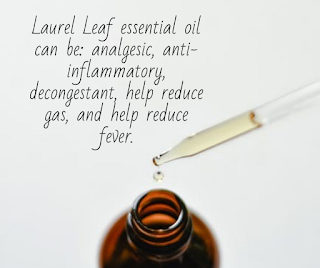
Laurel Leaf


Native to the Mediterranean, laurel leaves are a symbol of victory in Greek mythology and were used as a head decoration to symbolize rank and achievement. For example, the winner of the ancient Olympic games was traditionally given a laurel wreath.


Laurel Leaf essential oil (Laurus nobilis) is steam distilled from the leaves of the shrub. It is most commonly harvested in Turkey or Bulgaria.

Laure Leaf is also referred to as bay leaf. What is the difference? Bay leaf is the culinary term for laurel leaf. Bay leaves are sometimes used in flavoring soups and stews.

Laure Leaf essential oil has an herbal, spicy, and somewhat minty scent. There is a hint of sweetness at the end, which I think must come with that slight minty-ness. It's a wonderful smelling oil!


Laurel Leaf essential oil is good for cleaning. One of its main chemical constituents is eucalyptol, which is highly cleansing (and this is probably where it's herby, eucalyptus-type scent comes from). It is gentle enough to be used to help cleanse the skin, yet powerful enough to be used as a refreshing surface cleanser.

Laurel Leaf essential oil can be helpful with circulation and purification and also with lymph congestion. Try it in a massage diluted in your favorite carrier oil to help support the body's natural detoxification process.


Laurel Leaf is very supportive for the respiratory system as well, and can be used in a steam. To make a steam, pour almost boiling hot water into a heat safe bowl, set it before you on a table, and add one drop of an essential oil or blend. Drape a towel over your head to make a "tent", and then breathe deeply of the essential oil enhanced steam. Make sure you close your eyes! I find it so soothing and it usually clears me right up. Sometimes you need to do it more than once.


Combine in a 5 ml bottle with an orifice reducer and use it throughout the season for your steams. You only need one drop per steam. 

Energetic and Emotional Properties of Laurel Leaf essential oil: Laurel Leaf uplifts the mind and can help with focus and concentration. It can help move stuck energy, both emotional and energetic, and give you a confidence boost.


Tuesday, November 30, 2021

Rose: The Queen of Oils


The rose most commonly used to make essential oil is Rosa damascena, or the Damask Rose.

It can take up to 600 bushels, or up to 36,000 pounds! of rose petals to make 1 pound of rose oil. 😮 🌹 This is one of the reasons that pure rose essential oil is so expensive. 

Luckily, there is also rose absolute oil. It still takes a lot of rose petals to make an absolute, but not as many. An absolute is made by solvent extraction. How solvent distraction works is the plant material is mashed up and mixed with some type of solvent, usually a chemical substance like hexane or benzene. These chemicals attract the essential oil out of the plant material. Then the oil and the chemical are separated.

While it's true that some of the solvent may still be left in the oil, many in the perfume industry and some aromatherapists like absolutes because they are less expensive and easier to obtain.

Rose essential oil is one of the highest vibrating essential oils, and it has many therapeutic benefits. One of the many benefits is it's healing affect on the skin. Rose is anti-inflammatory and anti-bacterial, as well as an astringent. It has healing qualities that are great for aging skin.

Another great benefit of rose oil is that it is a CNS sedative, so it is calming and soothing for the mind. You could try using rose essential oil in a bath, and get the benefits of both its stress relieving qualities and its skin healing attributes! Rose essential oil may also be helpful for balancing hormones during PMS and menopause. Instead of a warm bath, using it in a cooling mist may help soothe hot flashes. 


Rose water has a long history of being distilled for medicinal purposes and beauty rituals. There is some evidence that the people of the ancient Indus valley were distilling floral waters in the fourth century BCE.


Mesopotamian tablets reveal that the art of extracting perfume date from 3500 BCE. Boiling the petals in water was used to release the scent of the roses.

The use of wild roses was confirmed by the medical treatises of the founders of Ayurveda (an Indian system of medicine). Different rose species held unique medicinal properties, and each was allocated an original Sanskrit name that suggested its curative properties.

Rose hips are the fruit of the rose and contain its seeds. Rose hips are very high in Vitamin C. You can use them in cooking and medicinal remedies. You can often find rose hips made into a tasty tea.


The Romans were obsessed with roses. They celebrated the rose in art, gardens, banquets, rituals, architecture, and daily life. This huge obsession came with a high demand. Most Roman roses were grown in Egypt, along the Nile, and in the Middle East.

The Roman Emperor Heliogabalus (c. 203-222 CE) threw a feast to commemorate the start of his reign. He wanted it to be memorable, so at the feast he locked his guests in the banquet room and showered them three times with rose petals. The quantities of petals used was so overpowering that several people actually suffocated under their weight!

Just like the Greeks, the Romans used rose oil for numerous medicinal uses. The Roman Pliny, in 77 CE, recorded thirty-two different medicinal uses for roses. All parts of the flower were used for headaches, earaches, and issues with the mouth, gums, tonsils, stomach, rectum, and uterus.

Rose oil was an early cure for hangovers, as Pliny wrote that the crowns of roses would alleviate the "pain in the head" from wine with "very refreshing effect" (quoted in Potter, The Rose: A True History). Something to keep in mind the next time you have a party coming up!

The Romans weren't the only ones who used roses for medicinal purposes. Islamic medicine had also noted rose water and rose oil's benefits for the eyes, for relieving headaches, and for relieving diseases of the mouth and stomach. And the English botanist John Gerard wrote in his book; Herball, or Generall Historie of Plantes, that rose water and rose oil could help with eye issues, stomach issues, and internal inflammation, specifically constipation and fevers. And as I've already mentioned above, the founders of Ayurveda also recognized the important medicinal benefits of the rose. 


Rose is the Oil of Divine Love


Rose oil is not only a powerful healer of the physical body. It is also a strong spiritual healer. As rose helps to heal the body, it also helps to heal the mind, as rose teaches the need for divine grace and intervention in the healing process.

The Rose is often associated with powerful female figures such as Venus, Isis, and Mary. These three women/goddesses are seen as healers, givers of life, nurturers, and the physical embodiment of love.

Rose is a supportive oil for the Heart Chakra. If you are feeling sad or depressed, massage a couple drops of rose oil over your heart and breathe deeply of the soothing, nourishing scent of the Rose.


Roses come in many different colors, and there is meaning in giving a certain color rose as a gift. Red roses signify passion and desire, pink roses are for love and romance. Yellow roses are for friendship, and white roses for sympathy and compassion. My personal favorites are the pink roses. 


Tuesday, November 2, 2021

Tea Tree (Melaleuca): The Oil of Energetic Boundaries

Tea Tree (Melaleuca alternifolia) essential oil is made by steam distilling the leaves of the plant. Although the leaves are what we use to make the oil, I think the flower of the plant looks pretty cool!


Tea Tree is the more common name for this essential oil, but you can also often find it called Melaleuca.

Tea Tree essential oil has a very sharp, herby-green, kind of medicinal scent. I couldn't imagine using it in a perfume, or even diffusing it alone. Diffusing Tea Tree though is a great way to take advantage of its therapeutic properties as it is an airborne anti-microbial.

Try pairing Tea Tree with citrus oils for a fresh, uplifting scent that also helps cleanse the air.

Here is a diffuser blend I like to use with Tea Tree. This smells great and with the anti-microbial properties this blend has, it does a wonderful job of purifying the air.


Due to its anti-microbial and immune stimulant properties, Tea Tree is a great oil to use for a steam. Steams can be so helpful for nasal congestion. Tea Tree essential oil also has great anti-fungal properties, and can be nurturing for healthy nails and skin. Always make sure to dilute when using.

Tea Tree essential oil is a great oil for the Throat Chakra. It's many therapeutic properties have been shown to support respiratory health, and energetically it can help us to speak up and feel less victimized. Tea Tree is the Oil of Energetic Boundaries.

Tea Tree has disinfectant therapeutic properties, and it also helps to clear out the emotional infections caused by negative energy. Tea Tree can help us clear out the toxic relationships we may have formed in our lives.

The negative emotions Tea Tree assists with: poor boundaries, weak-willed, drained, emotional toxicity, and toxic relationships.

Crystals that pair well with Tea Tree oil would be stones that support the Throat Chakra, such as turquoise, or other blue stones.

Some of the positive properties of Tea Tree: it helps support healthy energetic boundaries; encourages respectful connections; and helps us to feel empowered, resilient, and safe.


Saturday, October 2, 2021

Rosemary (Rosemarinus officinalis)


Rosemary is a common herb to use fresh or dried in many culinary dishes, but it is also an excellent essential oil to use in aromatherapy. 

Rosemary (rosemarinus officinalis) essential oil is made by steam distilling the little needle-like leaves, as well as the flowers, of the plant.


Rosemary essential oil has many therapeutic benefits including being anti-inflammatory and antibacterial. Due to its antibacterial properties, Rosemary is a good oil to diffuse, as it may help purify the air.

Another therapeutic property of Rosemary essential oil is that it is a stimulant to the Central Nervous System.

Inhaling the scent of, or receiving a massage with Rosemary can increase alertness and focus, and increase breathing rate and blood pressure. 


Energetic properties of Rosemary: The Oil of Knowledge and Transition

Rosemary can assist us with the gathering of true knowledge and intelligence. It challenges us to look further and deeper than we normally would and ask more soul-searching questions.

Rosemary is supportive to those who have learning disabilities.

Rosemary aids us in adapting to times of change. It supports us to feel confident and assured during challenging times.

Positive energetic properties of Rosemary: mental clarity, knowledgeable, teachable, enlightened, open to new experiences, ability to adjust.

Energetically, Rosemary is the oil of knowledge and transition. It can help support us in times of change and the pursuit of knowledge.


There isn't just one type of rosemary essential oil. Rosemary essential oil can come in different chemotypes, such as Rosmarinus officinalis ct. 1,8 cineole or Rosemarinus officinalis ct. camphor.

What the heck is a chemotype?

A chemotype is a separate version of a plant that has the same genus and species, but due to environmental conditions has created different chemical constituents. Not all plants create chemotypes, but Rosemary is one that does.

Because the different chemotypes of Rosemary have different chemical constituents, they are also going to have different therapeutic benefits. It's important to know which chemotype you want to use.

Tuesday, August 31, 2021

Peppermint

 Peppermint: 


Peppermint essential oil is wonderful for your digestive system. Having some indigestion? Put a drop of oil in a glass of water to drink or in a capsule. Inhale the aroma of peppermint to help with feelings of nausea. For bloating or gas, you can rub a couple drops of peppermint essential oil on your abdomen. Starting above your belly button, massage gently in a clockwise motion (with 12 o'clock being at the spot above your belly button).

By the way, I don't recommend getting it in your eye. LOL I've accidentally done this! And while I was driving! I pulled over right away and luckily my husband was in the passenger seat and able to kind of take over. In the midst of my freaking out I tried to explain to him what had just happened and it came out as, "My eye! It's so squinty, and minty!" We've laughed forever about this, and often refer to it as the time I got the 'Ole Minty Eye. 


Peppermint essential oil can really perk up your mood! It contains menthol, which can bring circulation to your head and stimulate clarity and motivation.

Put one or two drops in the palm of your hand, rub your hands together, and then breathe deeply of the refreshing aroma. This is especially helpful to do in the morning if you're still feeling sleepy, or whenever you need a pick up.

Peppermint essential oil is the Oil of a Buoyant Heart.

Peppermint can bring joy to our hearts and uplift us out of times of discouragement and fear. It is good to use for a short reprieve, but not as a crutch. Let the power of peppermint help you through rough waters, but do not become dependent on it.

The positive energies of Peppermint: optimistic, joyful, relieved, strength to face emotional fear.

Energetically, peppermint pairs well with: Tangerine, Lime, Red Mandarin

Peppermint would be a good oil to use for the solar plexus chakra, as it is such a helpful oil for the digestive system, and it is generally uplifting to the spirit.


Tuesday, August 3, 2021

Roman Chamomile: The Oil of Spiritual Purpose


To often we fear that if we follow our dreams we will fail and become destitute. Roman Chamomile oil can help us shed the meaningless activities that take up too much of our time, and help us to focus on what matters as far as accomplishing our goals. Sometimes even goals for the soul. Roman Chamomile eases the overactive ego-mind and restores confidence to keep us on the path of achieving what we were put on this earth to do. 


Roman Chamomile essential oil is made by steam distilling the petals of the flower. It's emotional, or energetic qualities are that it may reduce anxiety and calm and soothe an over-active mind. Therapeutically, Roman Chamomile is great for the skin and may help to reduce inflammation. 

You may be more familiar to using Chamomile as an herb in tea. Chamomile tea is calming for the mind, helpful for digestion, and tasty! 

In plant lore Chamomile symbolizes "patience in adversity". In ancient Rome, soldiers would use Roman Chamomile essential oil for courage before battle. 

This daisy-like flower is sometimes called the "plant physician" because it has positive effects on plants growing nearby. 


The scent of Roman Chamomile makes me think of apples and honey. In perfumery it is a middle note, with hints of green, floral, herbal, balsamic, and vanilla. 

In tarot, Chamomile is associated with the Ace of Swords. The Ace of Swords symbolizes the expansion of thoughts, enlightenment, and illumination. But, like with all double-edged swords, there is always another side to things. We must guard that our confidence and determination do not turn into aggressiveness and selfishness.  

Friday, May 7, 2021

Eucalyptus: The Oil of Wellness

Eucalyptus (Eucalyptus radiata)


It probably comes as no surprise that Eucalyptus would be the oil of Wellness, as it's a common go-to oil for aromatherapists when dealing with illness. Especially illnesses such as colds, congestion, and allergies. Eucalyptus has a strong influence on the throat, both physically and emotionally and it's a strong supportive oil for the Throat Chakra. 

Emotionally, Eucalyptus is supportive for those who are often getting sick. It is not only a helper for these individuals actual physical ailments but also for the emotional baggage of feeling that they are "always sick", or "I can't ever seem to get better", or "I only get attention when I'm sick". Eucalyptus helps with the confidence to let go of these beliefs and break the cycle of being ill. 

Eucalyptus is most commonly associated with Australia, where it's a favorite food of koalas! But Eucalyptus is also found in Spain, China, and I've even seen it grown places here in the U.S. The essential oil of Eucalyptus is made by distilling the oil of the leaves. 

Eucalyptus has a fresh, clean, green scent and is a common essential oil used in spas. Dried Eucalyptus leaves and branches are beautiful in floral arrangements. 

One of my favorite ways to use eucalyptus is with a steam. This can be super helpful if you're feeling congested.

Put one drop of therapeutic grade eucalyptus essential oil in a steaming bowl of hot water. Place the bowl on a table and sit in front of it, leaning over the bowl. Drape a towel or blanket over your head, also enclosing the bowl, so that you're trapping the steam inside your towel "tent". Relax and breathe deeply!

Make sure to be careful with the hot water, and don't use more than one drop of the oil.


Tuesday, March 30, 2021

Lavender - The Oil of Communication and Calm


Lavender (Lavendula angustifolia) is one of the most commonly used essential oils. It’s the one to have on hand for any number of issues, and one I always recommend is a good oil to start with if you’re just getting interested in using aromatherapy.


In Medieval times, there was some debate on how Lavender influenced love. Some people claimed that wearing it would help keep the wearer chaste, while other people thought it had aphrodisiac qualities that would create the opposite effect!


Lavender essential oil has a familiar herbal, floral, green scent. It has both sharper, almost camphor like notes as well as softer, powdery notes. A lot of people like the scent of Lavender, but I actually know some people who can't stand it! Synthetic Lavender scent can sometimes be too powdery, but actual Lavender is more fresh and earthy.


Many people associate Lavender with feelings of calm and tranquility. Lavender actually has properties that are sedative to the Central Nervous System, so enjoying the scent of Lavender really does help you relieve stress!


Lavender is one of my go-to oils for helping with better sleep. Spray a couple spritzes of this on your pillow before bed and drift away.


Cozy Night Linen Spray

(Combine all ingredients in a 2 oz. spray bottle)

14 drops Wild Orange or Bergamot

10 drops Cedarwood

20 drops Lavender

Fill the rest of the bottle with spring water

Shake before each use


Make sure you use either a glass bottle or a plastic bottle that is essential oil safe. Some EO's can actually eat through plastic and make a big mess.


Energetically, Lavender is the oil of communication and calm. It helps us to say what we really want to say despite the fear of being seen and heard. It helps unblock withheld expression and dissipate the stress of potential rejection. Lavender encourages emotional honesty and open communication.


Lavender is a Heart Chakra oil. Apply a drop to your heart and/or at the nape of the neck to encourage an open heart.


Lavender essential oil has anti-bacterial properties. I sometimes put a drop or two on a cut or scrape, after washing with soap and water. For healing support, Lavender works well with Frankincense and Helichrysum. Note that this only works with therapeutic grade essential oil. Synthetic fragrance oils will not have the same chemical properties.


Lavender is a common scent used in perfume making. It is a Middle Note, part of the body of a perfume and is considered an enhancer, modifier, and equalizer. It has an intensity of 2. Lavender blends well with a lot of oils. Almost all citrus oils go well with Lavender as well as floral scents like geranium. I also like lavender with woodsy notes and earthy scents.


Sources:

- doTerra.com

- Aromahead Institute

- Modern Essentials, Sixth Edition

- Emotions and Essential Oils, A Reference Guide to Emotional Healing, 2017 Sixth Edition


Thursday, September 24, 2020

Patchouli: Those hippies were onto something.


Patchouli (Pogostemon cablin)


I didn’t used to be a very big fan of Patchouli. I think some of my free spirited friends in college wore way too much of it. While I liked the idea of the lifestyle patchouli invoked, I couldn’t abide the way that lifestyle seemed to smell. Until recently, whenever I smelled Patchouli it would bring up memories of late night coffeehouse conversations and hula hooping at outdoor music festivals.


Today though I have a very different relationship with Patchouli, a more mature one you might say. It started a few years ago when I was doing massage at a spa where we used an aromatherapy blend that was for relaxation, and I loved the smell of it. I looked into what oils were in the blend and was surprised that Patchouli was one of them. Since them I have noticed that I’m often drawn to aromatherapy blends and perfumes that contain Patchouli. It seems to lend a sort of deep, soft, grounding glue to these blends. It’s the subtle but powerful boss babe running the show from backstage. In control, but not needing the spotlight because she knows she’s got this.


The scent of Patchouli is sultry and dark. It has herbal, woody, narcotic notes, and an almost antiseptic or insecticide finish. This is a bit ironic because Patchouli is actually a great oil to use as a bug repellant.


Energetically, Patchouli helps us feel connected to our bodies. For obsessive personality types this oil can be especially grounding. It calms fear and nervous energy and fosters better synergy between the body and mind. It can be helpful for easing mild depression. Use Patchouli for yoga, tai chi, or my favorite, when you go out dancing!


Patchouli is very helpful for the skin. Historically it’s been used for toning the skin and may be helpful in anti aging skincare blends. It is anti-inflammatory, anti-fungal, and antibacterial.


I was surprised to learn that Patchouli is actually part of the mint family. The essential oil is made by steam distilling the leaves of the plant. The flowers when in bloom are a beautiful lavender color that somewhat remind me of lilacs (as far as their look, not smell!) It is high in sesquiterpenes and sesquiterpenols, which give it it’s skin healing anti-inflammatory and antioxidant properties.


For centuries Patchouli has been used in perfumes. It is a base note, and blends well with florals like Lavender, Rose, and Jasmine, and with other woody base notes like Sandalwood, Frankincense, and Vetiver. 

Sources:
- doTerra.com
- Aromahead Institute
- Modern Essentials, Sixth Edition
- Emotions and Essential Oils, A Reference Guide to Emotional Healing, 2017 Sixth Edition


Cardamom (Elettaria cardamomum)

  Cardamom essential oil is a wonderfully supportive oil for your digestive system. It is made from steam distilling the seeds of the cardam...